
CD Style
DISC Assessments | Values Assessments | The How and WHY of personal success
 Rating 4.9/5 by 1200 + Professionals
Within the DISC model, many people fall into blended patterns rather than a single dominant quadrant. One of the most structured and results-focused combinations is the CD personality type. This blend brings together the precision of the C style and the decisiveness of the D style, creating individuals who balance analytical thinking with a strong drive for results.
A CD DISC personality often appears in roles that demand both strategic thinking and accountability for outcomes. These individuals want decisions grounded in logic, data, and measurable standards, yet they are also comfortable taking charge when progress is needed.
Organizations frequently encounter this blend in technical leadership roles, operations management, engineering, analytics, finance, or quality control. The combination of attention to detail and determination can help teams move forward without sacrificing accuracy.
Within the broader DISC personality styles, the CD blend represents a disciplined approach to leadership and problem-solving. While a pure D may push for speed, and a pure C may pause for analysis, the CD combination reconciles both perspectives.

What do the C and the D in DISC mean?
The letters in DISC represent four behavioral tendencies: Decisive (D), Interactive (I), Stabilizing (S), and Cautious (C). Each reflects how individuals approach tasks, people, and decision-making.
The C dimension represents cautiousness. Individuals who score high on the C dimension tend to have structured processes and standards. Logic and accuracy also play an important role for them. They tend to consider the data before coming to any conclusion.
The D dimension reflects decisiveness. Those with strong D tendencies take initiative, move quickly, and focus on achieving outcomes. They are comfortable challenging obstacles and pushing projects forward.
In the DISC CD personality, these two forces combine. The cautious side pushes for evidence and structure. The decisive side demands action and progress. The result is a personality style that values both analysis and execution.
What is a DISC style blend?
Many individuals are influenced by more than one quadrant of the DISC model. When two styles appear prominently on a profile, they form a blend.
A CD DISC style is one such combination. The person displays traits from both the C and D quadrants rather than operating entirely within one.
Blended styles help explain workplace behavior more accurately than single labels. For instance, someone with the DISC CD blend may approach problems analytically like a C, yet still take initiative like a D.
Organizations often compare this blend with others, such as the ID style, CS style, DI Style, or IS Style, each reflecting a different combination of behavioral drivers.
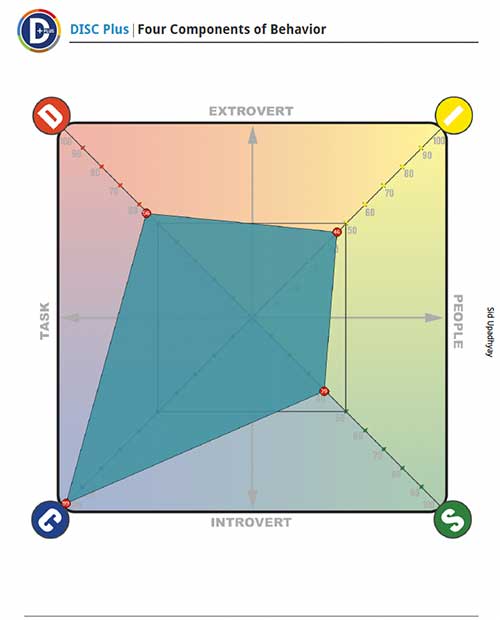
Dot placement
In a DISC CD personality chart, the dot typically sits between the cautious and decisive areas. Placement closer to the edge suggests stronger intensity in those behaviors.
Professionals reviewing a DISC profile CD often examine how far the dot moves from the center. The farther it sits outward, the more consistently the person expresses those traits in daily behavior.
How do you get typed as a CD style in DISC?
A person is identified as the CD personality type through a structured questionnaire used in a CD DISC assessment. Participants respond to behavioral prompts describing workplace actions and preferences.
The scoring process evaluates patterns across the four dimensions of the DISC model. If both the cautious and decisive factors appear prominently, the result may classify the individual within the CD DISC profile. During a DISC assessment, CD responses that reveal strong analytical thinking combined with results orientation often lead to this blend classification.
Organizations rely on these assessments for leadership development, hiring insights, and team alignment. A well-interpreted CD DISC assessment can clarify how a person approaches challenges, communicates ideas, and handles pressure.

DISC CD style characteristics
Common Traits
People with the CD DISC personality often display the following tendencies:
- Analytical and logical thinking
- Direct communication style
- Strong focus on efficiency and outcomes
- Preference for evidence before making decisions
- High expectations for accuracy and performance
These traits often appear when someone combines the determination associated with DISC D Styles and the precision linked to DISC C Styles.
Motivations
The DISC CD blend is motivated by improvement and measurable success. These individuals enjoy refining systems, solving complex problems, and achieving tangible results.
They gain satisfaction when analysis leads to clear progress.
Priorities
Typical priorities include:
- Correct decisions supported by evidence
- Efficient processes
- Measurable outcomes
- Professional credibility
Compared with DISC I Styles or DISC S Styles, CD individuals focus more heavily on logic and task performance.
What They Value
Accuracy and productivity are usually at the center of their work philosophy.
Stressors in the Workplace
Common stress triggers for the CD DISC style include:
- Lack of clear standards
- Inefficient processes
- Decisions made without data
- Unstructured environments
Situations that feel chaotic or ill-defined can create frustration.
Fears
The biggest concerns for many with this blend involve:
- Being associated with flawed results
- Working within systems that lack discipline
- Losing control over quality or outcomes
How They Influence Others
Individuals with a DISC CD personality influence through expertise and decisiveness. They tend to persuade colleagues using data, structured arguments, and clear direction.
While I-style personalities may rely on enthusiasm, CD types often rely on credibility.
How They Handle Conflict
Conflict does not typically intimidate a CD individual. They address disagreements logically and expect others to support their arguments with facts.
Their direct approach can resolve issues quickly, though some colleagues may perceive it as blunt.
May Need to Work On
Even strong performers benefit from areas for development. Many CD professionals benefit from focusing on:
- Patience with slower decision processes
- Greater flexibility when circumstances change
- Listening to perspectives that prioritize relationships
These adjustments help balance analytical strength with team collaboration. Some leadership programs also include DISC training certification, allowing HR teams and coaches to interpret assessment results with confidence.

CD-Style managers
Because of their analytical mindset, they are strong at diagnosing operational problems. They also hold teams accountable for meeting standards.
In leadership roles, the DISC CD personality often excels in environments where accuracy, compliance, or strategic execution matters. Technical departments, operations teams, and research units often benefit from this leadership approach.
Working well with DISC CD-style people
Understanding the CD DISC profile can improve communication and teamwork.
Communicating with CD styles
Communication with CD personalities works best when it is structured and factual.
Provide relevant information, keep messages concise, and support ideas with evidence. Emotional appeals or vague arguments tend to be less persuasive.
CD styles in meetings
In meetings, individuals with a DISC CD blend usually prefer clear agendas and defined outcomes.
They appreciate discussions that stay focused on objectives. When meetings drift without direction, they may become impatient.
Problem-solving with CD styles
Problem-solving often plays to the strengths of the CD DISC style. They naturally examine root causes, evaluate data, and design structured solutions.
When teams pair their analytical approach with collaborative perspectives from other DISC personality styles, the results can be powerful.
Many companies eventually decide to buy DISC assessment packages to use the tool for hiring, leadership development, and team alignment.
Do CD-style people make good salespeople?
Sales success depends heavily on context. In technical or consultative sales environments, the CD DISC personality can perform extremely well.
These professionals often excel when selling complex solutions that require detailed explanations or data-based arguments. Their credibility and precision help build trust with analytical buyers.
In contrast, highly relationship-driven environments might favor styles closer to the ID style or other communication-oriented blends.
Similar styles: C and DC
The C style
The C style emphasizes analysis, precision, and structured thinking. Individuals within this quadrant focus heavily on accuracy and quality control.
They may appear similar to the CD style, though they often move more cautiously when making decisions.
The DC style
A DC blend reverses the emphasis found in the CD combination. While both styles include decisiveness and analytical thinking, the DC pattern leans slightly more toward dominance and speed.
Understanding these nuances helps organizations interpret a DISC CD personality more accurately.
Other styles
The DISC model contains many combinations beyond the CD pattern. For example:
- ID style blends interaction and decisiveness
- CS style combines stability with cautiousness
Each variation contributes a different strength to team dynamics. Organizations evaluating personality tools often start by reviewing the DISC assessment cost before adopting the platform across teams.
FAQ’s
What is a CD personality type?
The CD personality type represents a blend of cautious and decisive behaviors in the DISC framework. Individuals with this pattern combine analytical thinking with a strong drive for results.
What is the rarest disc profile?
Rarity varies across datasets and industries. Blended patterns like the DISC CD personality type appear less frequently than some single-style profiles, though the distribution varies by organization.
What is a CD assessment?
A CD assessment refers to a behavioral evaluation that identifies individuals whose DISC results combine cautious and decisive traits. The DISC assessment CD profile highlights analytical thinking alongside action-oriented behavior.
What are the 4 DISC personality styles?
The four core styles are Decisive (D), Interactive (I), Stabilizing (S), and Cautious (C). These form the foundation of the DISC model used in workplace behavioral assessments.
What is a CD profile?
A CD DISC profile describes someone whose behavioral style blends cautious analysis with decisive action. It reflects both precision and results orientation within the DISC framework.